 Instancium
Zero Silent Truncation
The context you send is the context the model sees. No hidden pruning of conversation history and no silent summarization behind your back.
Instancium R&D Laboratory · Foundational Inference Platform
AI that answers from infrastructure you control. InstantAIGate keeps conversation memory, data flows, and model execution inside the perimeter your organization owns — and gives your engineers explicit command over each of them.
InstantAIGate is not a demonstration project or a thin wrapper around someone else's engine: it is the foundation on which Instancium builds its own applications. Sovereign assistants, research pipelines, and the laboratory's internal tooling run on this gateway in production. What we publish is the same foundation we depend on ourselves.
“You cannot control an intelligence if you do not control its memory.”
Most hosted AI services manage conversation memory on your behalf: hidden sliding windows, lossy summarization, invisible system prefixes. This is operationally convenient and impossible to audit. InstantAIGate takes the opposite position — memory is an explicit, observable resource that your team allocates, inspects, and controls.
The gateway is deliberately specialized on the Qwen family of models. Specialization here is an engineering decision, not a limitation: a narrower set of supported configurations allows each one to be thoroughly tested, deterministic in production, and efficient on real hardware. Extreme stability and predictability are prioritized over experimental feature volume.
The context you send is the context the model sees. No hidden pruning of conversation history and no silent summarization behind your back.
Long sessions degrade when memory boundaries shift unnoticed. Explicit KV-cache checkpoints and token boundaries keep reasoning stable across many turns.
At any moment you can see how much memory a session occupies, how many tokens it holds, and when its state changed. Control begins with visibility.
Each capability below addresses a concrete operational risk: uncontrolled memory growth, silent context loss, opaque session state, and blind spots in production. Together they allow Instancium to run its own applications on this gateway without continuous manual intervention in the inference layer.
Model memory (the KV cache resident in VRAM) is a managed resource, not a black box: roll a session back to a known checkpoint (RollbackSession), excise intermediate turns while preserving the system prompt (ShiftSessionCache), and reuse shared prefixes across concurrent sessions. In planning terms: predictable VRAM consumption and lower hardware cost per conversation.
The gateway does not rewrite your context silently. If a session exceeds its memory budget, execution halts with an explicit ContextOverflowException instead of corrupting memory or crashing the engine. Failures stay loud, bounded, and recoverable.
A single persistent two-way channel (/hub/chat) transmits only the delta changed since the previous turn, keeps session state resident in VRAM between turns, and tokenizes media once. The practical effect: smaller payloads, faster first token, less network waste.
A dedicated telemetry hub (/hub/telemetry) streams VRAM context leases, queue backpressure, and native engine output at 1Hz. Operators see vital signs live instead of reconstructing them after an incident.
InstantAIGate separates three concerns that are usually tangled into a single monolith: the client application that orchestrates conversations, the gateway that manages sessions and memory, and the native engine that executes tensor operations on hardware.
For an architect, this means each layer can be upgraded, replaced, or audited independently. For a CTO, it means no single component becomes a point of absolute control — or a single point of failure.
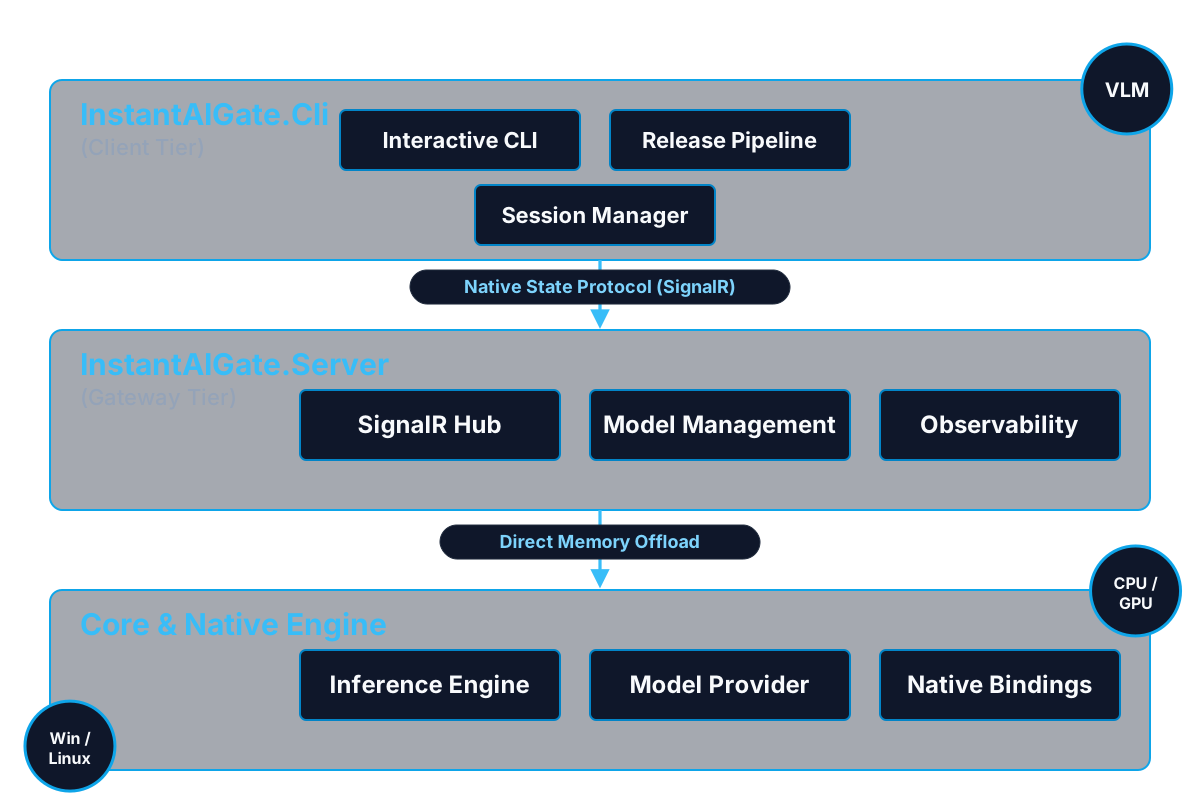
Any environment that can hold a WebSocket: JavaScript/TypeScript, Python, Go, Rust, .NET. The open-source InstantAIGate.Cli ships as a reference implementation, so integration patterns are learned from working code.
SessionChatHub maps each connection to a leased native memory handle and executes KV-cache operations without mutating context: high concurrency with strict session boundaries.
Compiled llama.cpp / mtmd runtimes interact with hardware directly, without a virtualization layer in between. Performance without an intermediary tax.
Inference runs on llama.cpp with a native Vulkan backend. In procurement terms
this reduces dependence on a single GPU vendor and on heavy proprietary stacks such as CUDA:
the same gateway executes on NVIDIA, AMD, Intel Arc, and Apple Silicon graphics —
on workstations, servers, and edge devices inside a private network perimeter.
This is the practical form of Dynamic Balance. Bulk, non-sensitive computation may remain in centralized clouds, while critical inference runs on infrastructure you own. The two models coexist; the position of the boundary stays a decision of your organization.
| Vendor / Architecture | Supported Models & Backends |
|---|---|
| NVIDIA GPUs | GeForce, Quadro, Tesla (via Vulkan ICD) |
| AMD Radeon GPUs | RX series, Vega, RDNA architectures |
| Intel Graphics | Arc & Integrated (Xe architecture) |
| Apple Silicon | Via cross-compilation and Metal-Vulkan translation layers |
Operating Systems: Windows, Linux, Edge devices within private network perimeters.
For .NET teams, the InstantAIGate.Core package exposes every wire contract
as a strongly-typed DTO: no manual JSON parsing, compile-time safety, and upgrades that
surface breaking changes in the build rather than in production.
An interactive CLI demonstrates the memory primitives in working code: token budgeting,
checkpointed ingestion, and the /ctx shift / /ctx rollback
commands. The fastest way for an engineer to feel what controlled memory means.